DROPLET LAB logo
Fluidraft Module 003
Advanced Droplet Microfluidics

Design droplet generators with models that know their limits.

Droplet behaviour has no universal equation — so DROPLET LAB doesn't pretend it does. Predictions come from a model registry where every model states its source, its exact definitions and its validated domain: assign continuous and dispersed phases with traceable properties, set the flows, and get regime, droplet size and frequency — or an honest refusal when your operating point leaves the model's domain. Then sweep, map the operating space, and see what your fab's tolerance does to the droplets.

DROPLET LAB is a paid module inside Fluidraft — native T-junction geometry, the same solver, the same project file. In the browser demo it appears in its locked preview; in an unlicensed Fluidraft install it runs fully, watermarked, so you can evaluate it before buying.
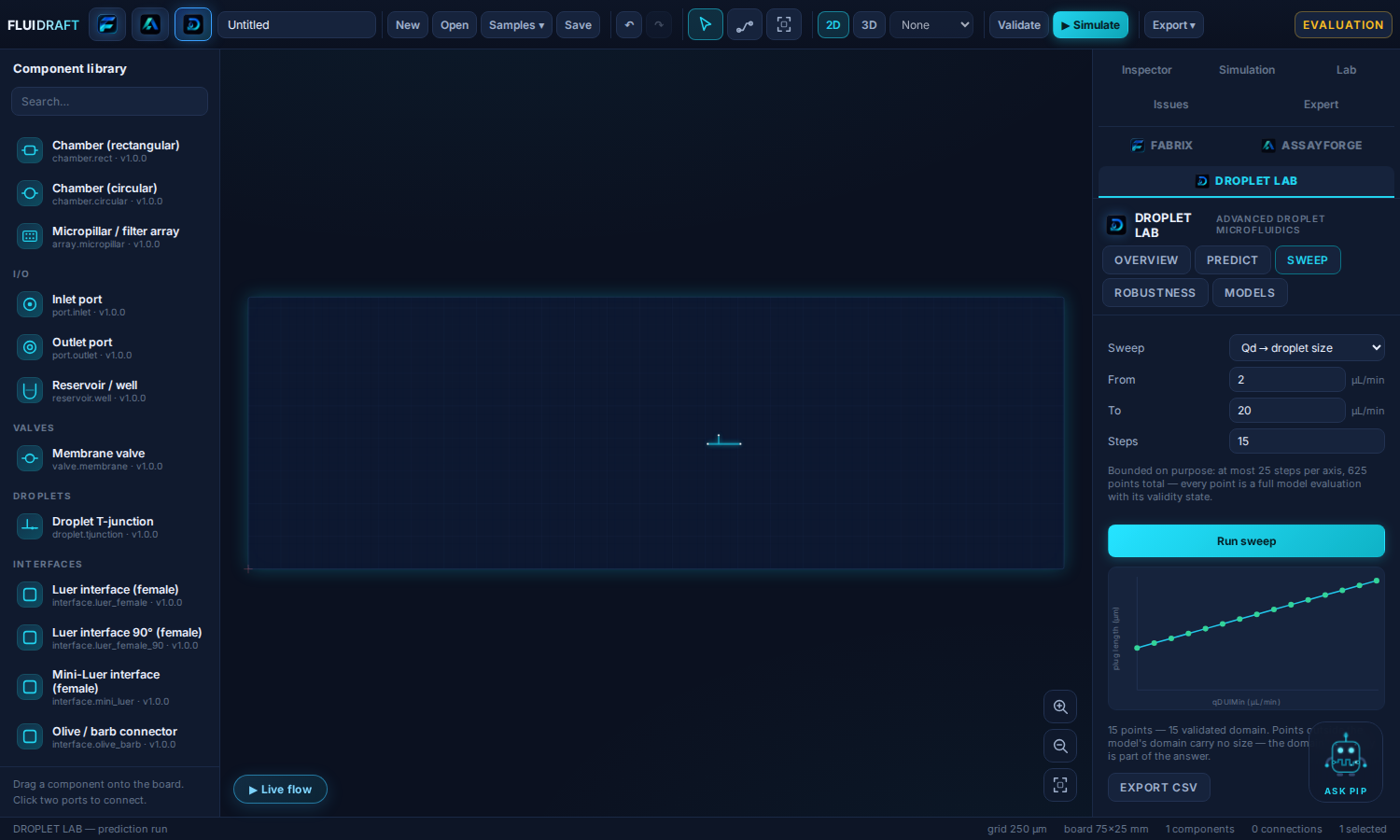
DROPLET LAB inside Fluidraft: a parameter sweep with validity-coloured points next to the live CAD canvas

Predict, explore, and stress-test — on the live design

Predict

Regime, size, frequency — with a status light

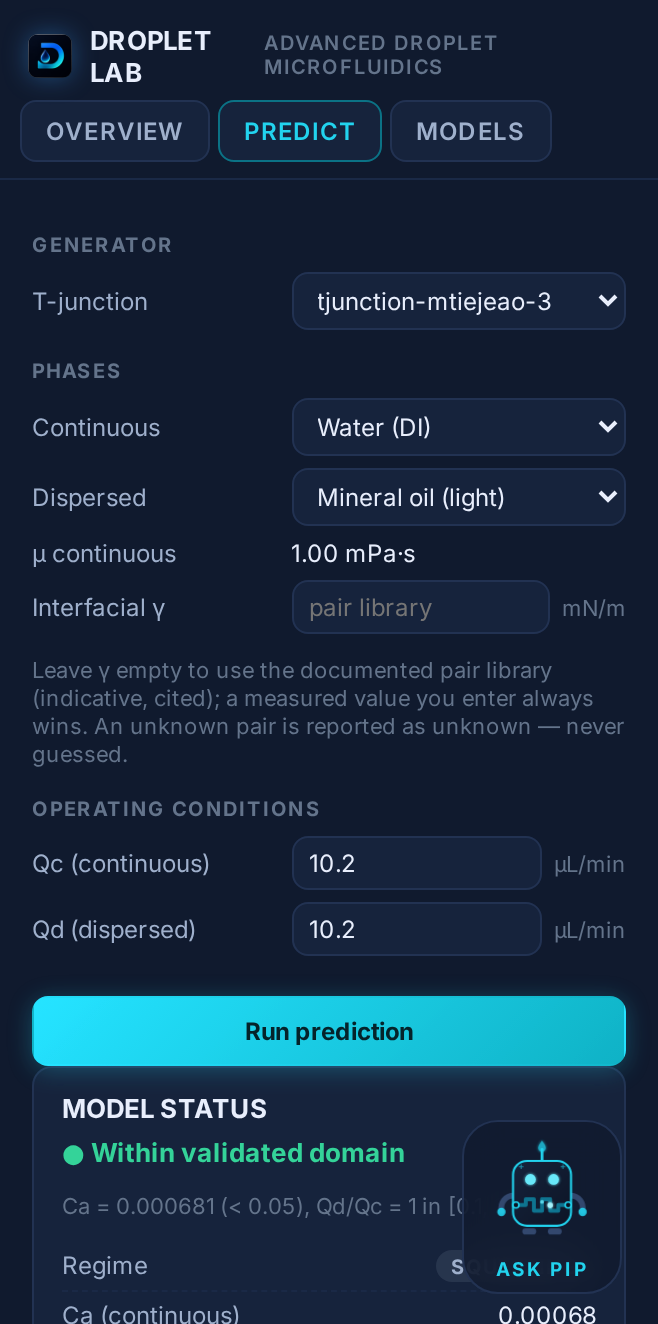
Pick a T-junction from the board, assign the phases, set Qc/Qd. The prediction leads with MODEL STATUS — within validated domain, near its boundary, or withheld with the reason. Displays are honest about precision: ≈ 210 µm, two significant figures, never six decimals of false confidence.

● Within validated domain · SQUEEZING · plug ≈ 210 µm · ≈ 160 Hz
Models

Every number names its model

The MODELS view shows the registry with full provenance: the Garstecki T-junction squeezing scaling — Lab on a Chip 6 (2006) — with its exact input definitions, its validity domain, and its known limitations. The implementation is checked by automated test against the coefficient band an independent study fitted to the original experimental data (α = 1.13 ± 0.16, Phys. Fluids 2017).

Sweep & map

The operating space, honestly drawn

Bounded 1D sweeps and the Qc × Qd operating map, every point a full model evaluation. Points outside the model's domain appear as out-of-domain — the boundary is part of the answer, not hidden behind an extrapolated curve. Export everything as CSV, validity column included.

Robustness

Your fab will miss nominal. Do the droplets care?

State a width tolerance — or let the FABRIX process profile prefill it — and get nominal → manufacturing range for size and frequency, through the same tolerance conventions as the rest of Fluidraft. Samples that leave the model's domain are counted and excluded, never extrapolated. Not a yield figure, and it says so.

100 µm ± 5 µm → plug 210 µm, range 195 – 227 µm
DESIGNPHASES + FLUID PAIR PREDICT · model status SWEEP / MAP ROBUSTNESS FABRIX checkEXPERIMENT

Five states. Numbers only in the first two.

Every prediction carries a machine-readable validity state. Outside the domain, DROPLET LAB explains itself and withholds the numbers — an unreliable prediction is worse than none.

VALIDATED DOMAIN — predictions shown
NEAR BOUNDARY — shown, flagged as first estimates
EXTRAPOLATED — withheld, with the range that was left
UNSUPPORTED — wrong regime for this model
?INSUFFICIENT DATA — e.g. no interfacial value for this pair
No universal droplet formula. Different geometries, fluids and regimes need different models. DROPLET LAB ships a model registry with validity domains — never one equation stretched over everything, and never silent extrapolation.
Pair properties are never invented. Interfacial tension belongs to a pair of fluids. Your measured value always wins; the documented library values are labelled indicative and cited; an unknown pair stays unknown — and the model answers INSUFFICIENT DATA instead of guessing.
Not multiphase CFD. These are validated reduced-order correlations for engineering design — fast, transparent, and honest about their envelope. For high-fidelity two-phase simulation, hand off to your CFD tool; Fluidraft's exports are built for exactly that.

In the workbench

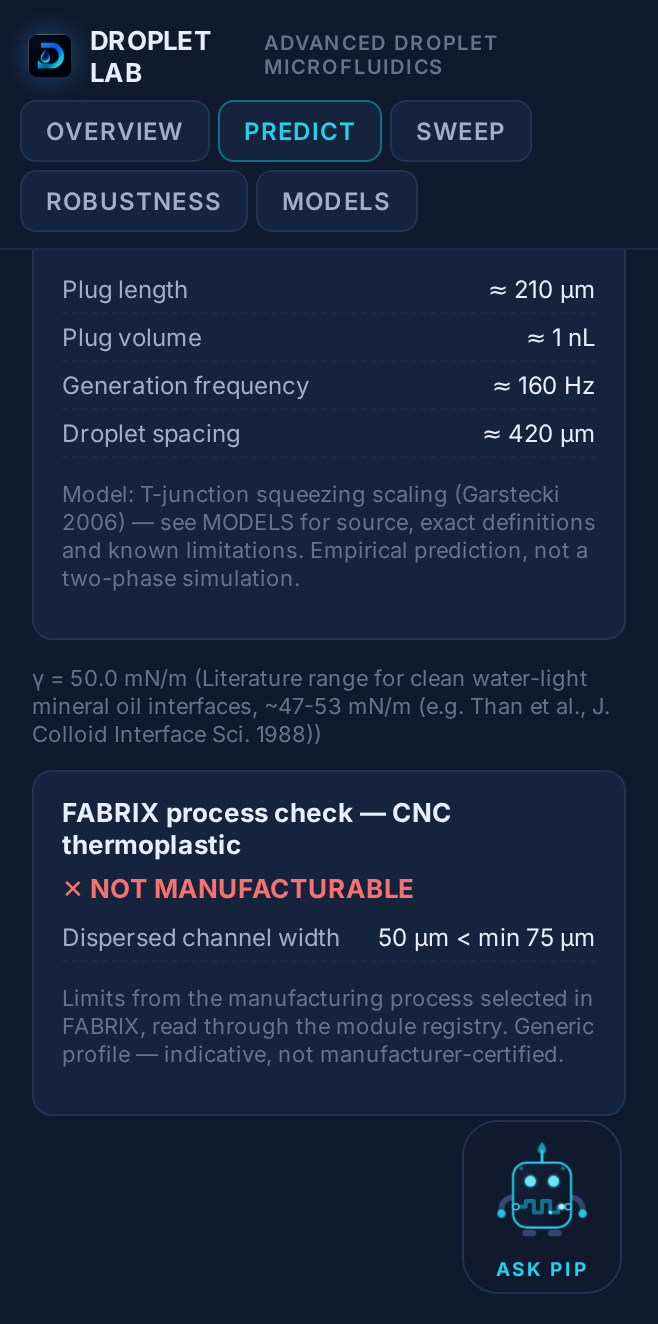
The Predict view: phases, flows and a validated-domain prediction with model status
PREDICT: phases with a cited interfacial pair, flows, and the answer led by MODEL STATUS — regime, Ca, plug ≈ 210 µm, every number naming its model.
The FABRIX process check beside a droplet prediction: NOT MANUFACTURABLE, 50 µm below the 75 µm minimum
The FABRIX bridge: droplet performance and manufacturability side by side — a 50 µm dispersed arm against a 75 µm CNC minimum, stated with both numbers.
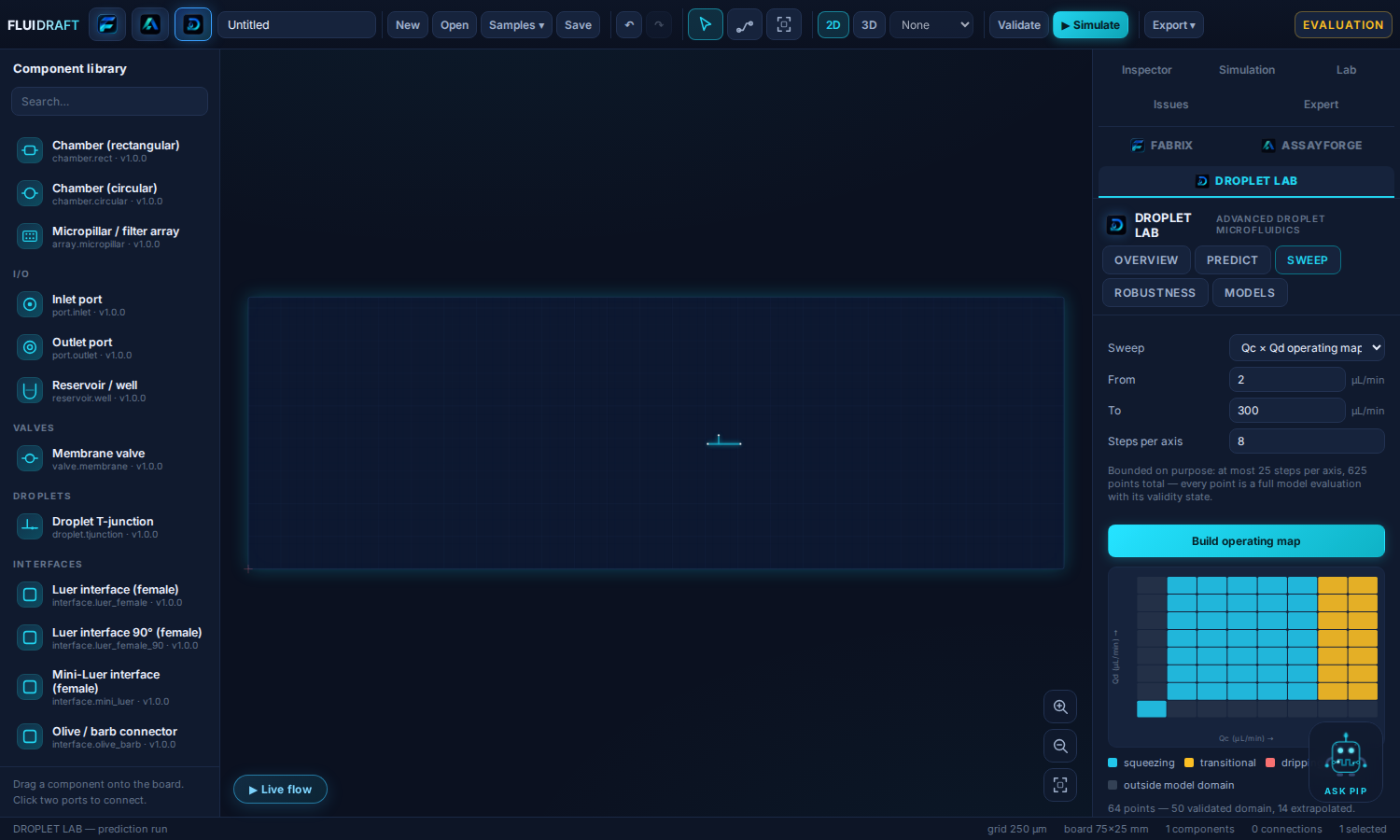
The Qc x Qd operating map with regime-coloured cells and out-of-domain cells greyed
The operating map: squeezing / transitional / dripping cells, with out-of-domain cells greyed — the domain edge is data, not decoration.
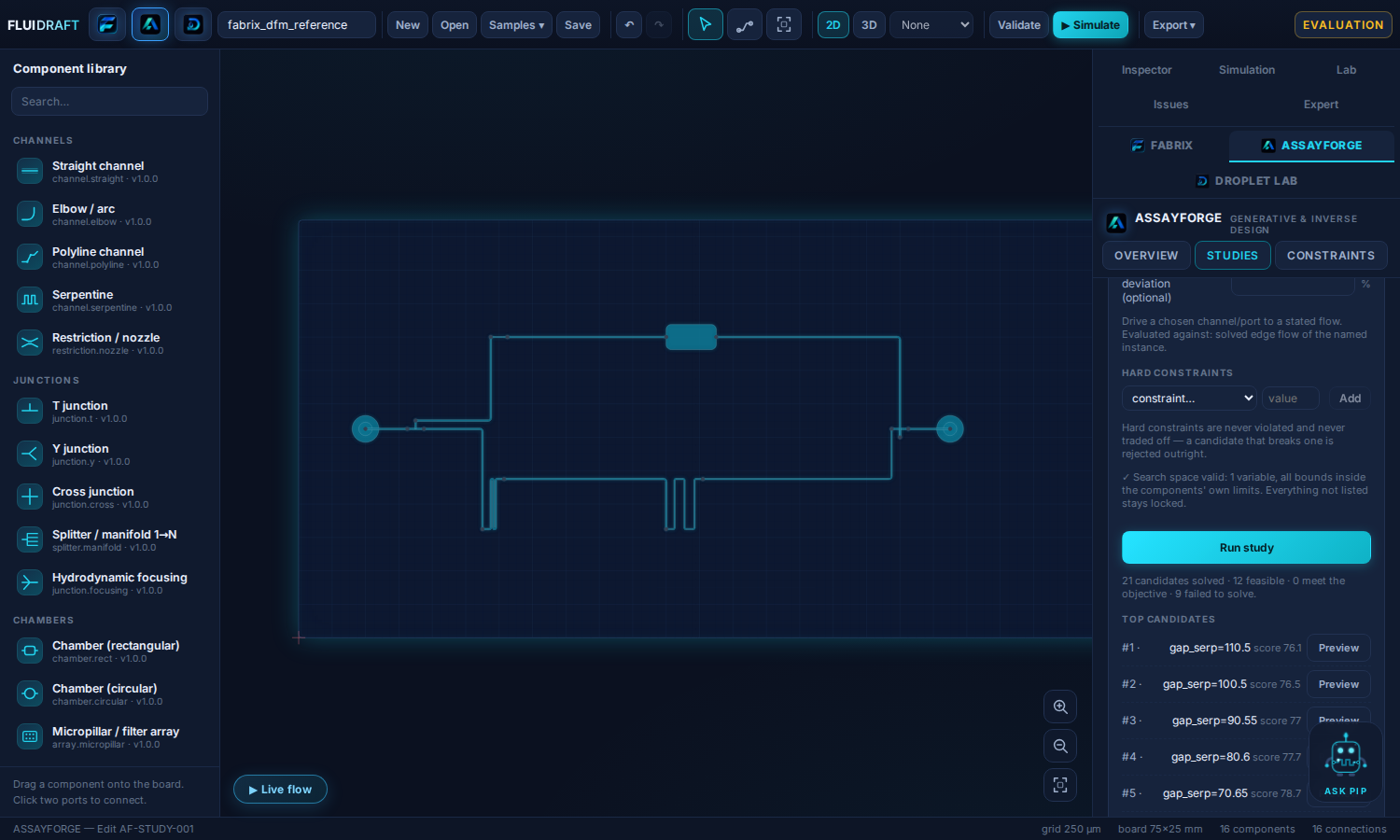
An ASSAYFORGE study optimising a droplet generator through DROPLET LAB's model
With ASSAYFORGE: “hit a target droplet size” becomes a search objective, scored by this module's validated model.

Activation is a file, not a phone call home

DROPLET LAB is switched on by your Fluidraft licence — one signed, offline file carrying Core and your modules together. Install it from the licence chip and the module unlocks in place. No online activation, no account, no telemetry.

DROPLET LAB is a subscription add-on to your Fluidraft plan — $49/month, or $490/year with two months free — and is carried by the same signed licence file. Letting it lapse never breaks Fluidraft — and it never requires FABRIX or ASSAYFORGE: each bridge lights up when the other module is present and says so plainly when it isn't. The full suite (Core + all three modules) is $189/month or $1,890/year.

$49/mo
or $490/year — two months free · founding price · academic 50% off

Subscribe yearly →or monthly

Licence file by e-mail after checkout · academic 50%: write from your institution

  • Sold as an add-on entitlement to a Fluidraft licence — one consolidated licence file, updated when you buy
  • Independent subscription: renew Core and DROPLET LAB together or separately
  • Try before buying: in evaluation mode DROPLET LAB runs fully, watermarked like the rest of the product

Base Fluidraft never depends on DROPLET LAB — and the T-junction component, the regime estimate and the per-edge Ca/Re/We numbers remain part of core Fluidraft. A project that carries droplet systems opens unchanged on an unlicensed install — module data is preserved, never deleted.